As I turn 32 and having completed 5 years of being a crafter and a reader. I keep wondering how I can give more to the design community & to aspiring designers or anyone reading this grow in their life and bring about a change. This blog is my attempt to share insights, experiences, and lessons learned on a journey of creativity.
Before we begin, I want you to know something about me.
I am Ankur Yadav, a Product Designer who is currently working at Yulu. I come from a background where everyone around me was pursuing engineering but I never wanted to study that. I pursued Bachelors and then Masters in Computer Application, I quickly realised that this is also not for me. So during my last year of college, photoshop happened to me & I found my true calling. It all started with creating some illustrations which I will attach at the end of the blog for you to see & then finding an internship as a Graphic Designer and then a Product Designer. I like to spend whatever time I can get to read be it blogs, newsletter or books. Currently am reading Thinking Fast & Slow, Daniel Kahneman. Whenever I get some more time then I play games.
Let’s begin with the learnings.
If I could go back in time and tell my younger designer self one thing, it will be to learn from others around me. You will find it surprising how by just obeserving & keeping ears open can teach you so much, be it your manager, people you work with, people you admire or even from others mistakes.
Here are 5 learnings from my 5 years of my career as a designer.
1. Willingness to explore
Believe it or not, your willingness to do work speaks volumes about you. I learned this very late in my career that being open to tackling diverse challenges not only broadens my experience but also equips me to mentor others and easily solve future problems. This openness to exploration and dedication to hard work set Greeks who are pioneers of democracy, science, and philosophy set them apart from rest of the world.
One such story is about Archimedes of Syracuse who was a mathematician, engineer, inventor and a physicist.
The king of Syracuse commissioned the crafting of a crown as a tribute to the gods. The king became suspicious whether the crown made for him was of of pure gold or it had mixes of silver. He called upon his close friend Archimedes to solve the problem. Everyone knew that lump of gold weighs more than silver, the trouble was that no one knew how to work out the size of an irregularly shaped object like a crown. Archimedes spent time in public baths to relax. As he slipped into the water he noticed spilling of water over the edge, and he had a sudden flash of inspiration. All Archimedes had to do was find out whether a lump of pure gold, with the same volume as the crown, weighed more. in a fit of jubilation, leapt straight out of the bath and ran naked down the streets shouting “Eureka!”, “I’ve found it!” This simple yet ingenious method led to the discovery of what we now know as the Principle of Buoyancy.
For us in our own field of works, Archimedes’ tale is a reminder that our own ‘Eureka’ moments are within reach if we’re willing to keep exploring, innovating, and pushing boundaries.
2. Ask questions & build better
The word “Why” has german origins, it reflects human curiosity to find a satisfactory answer or purpose.
I was promoted as UX Designer after my internship at Yulu and was very young to design, the team was very small & young, we were 2 designers and 2 product managers. We were tasked with many projects to improve the Yulu app, one such project was Improving the Hamburger Menu & I gained some knowledge from my Senior designer by watching him work, I thought (hey this seems easy), just by quickly glancing at the problem & getting inspired by others work I designed only 1 such iteration for the Menu. I crafted a solution where I was providing a quick context of that particular Menu category as a secondary text. Let me help you visualize.
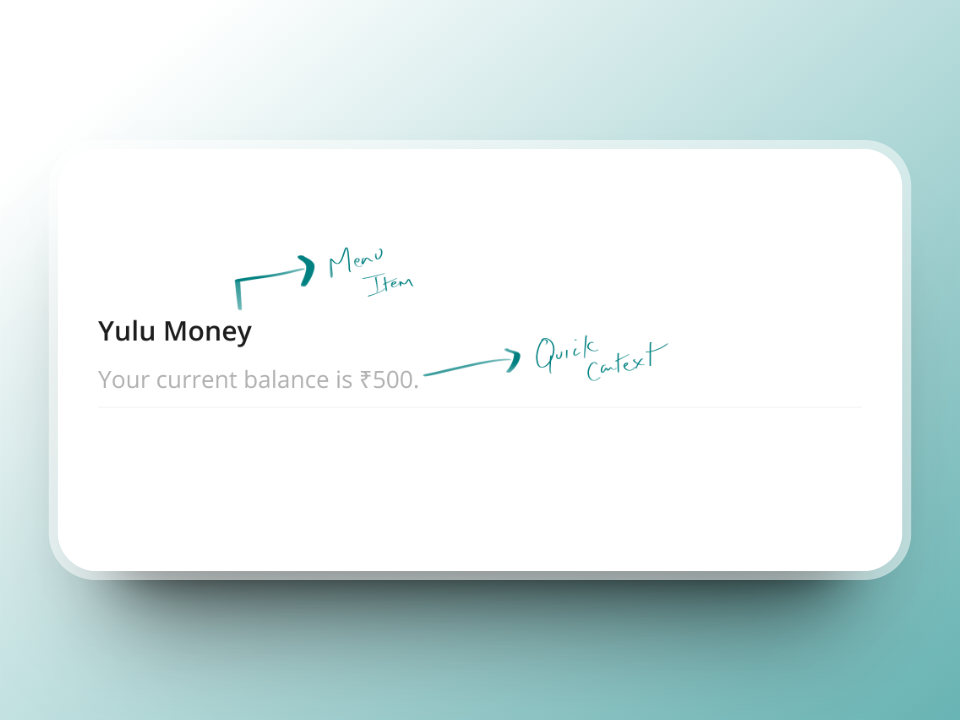
So I did the same for every Menu Item and thought to myself (this is great and will help users quickly gather information). But when asked “Why should we do this and what about other information present within the item” I had no answers. I kept asking myself “Why should it be like this”, “Is it even necessary”, “Would the user find this information helpful”. After some brainstorming sessions and interviewing users we had reached a solution which satisfied our business and helped users too.
Now, when faced with such decisions, ‘why’ is my Archimedes, helping me lead to deeper insights, stronger justifications for my choices, and ultimately, designs that satisfies stakeholders and helps users. So, my advice to you is to keep asking ‘why.’
3. Be open to collaboration
I have always been a firm believer of individualism and still am sometimes thanks to the first ever book I read which was “The Fountainhead” by Ayn Rand and for first 3 years of my career I have tried to do everything by myself and used to think that others slow me down, but now I will confess that some of the best work I have done is by working together with my team and achieving what we imagined.
One term which you will hear the most in your professional life and the term you will say most once you take on higher roles is “Collaborate” which is a latin word meaning “work together”. We all think that we collaborate enough, but in reality we do not. We collaborate with our team on designing the experience then we stop, we often miss out on working with developers and other key stakeholders and then end up on designing the experience again. True collaboration happens at every stage (kick-off’s, feasibility check, research, team brainstorming, handoff, UAT, etc) it just doesn’t stops at you designing the experience. Collaboration makes you a better designer, when you work with people who are integral part of the project you get to hear different perspectives and you design the best experience for your user.
We all feel stuck somewhere with our process where its hard to generate new ideas & we hit a mental block which frustrates us when we try to design a feature or even a product that stands out from the crowd. One thing that can make you learn and put out the best work is by collaborating with your team, with developers, managers and anyone else who can support and inspire you.
4. Document everything
During my first year in the world of design, I worked on revamping multiple features & every time I used to rely on my memory for remembering instructions told to me during kick-off’s. I struggled to explain the flow or the rationale behind the idea, even though they were exciting & were often improvement because I never documented my thought process or reason behind my decision making. This was very careless of me and didn’t bode well for me as a designer. Then I learned about a fact that Documentation is crucial for progress.
History has told us that it is invaluable to preserve knowledge & how does one preserve’s knowledge is by jotting it down. One such example is:
On 13th March, 1781 William Herschel discovered Uranus while surveying the stars in the night. He noticed that one of the stars seemed different and noticed that it orbited the Sun. He documented the detailed positional data and everything related to his discovery. Alexis Bouvard who was an astronomer and director of Paris Observatory accurately predicted the locations of Jupiter & Saturn but his prediction for Uranus failed, leading him to hypothesise the irregularities in Uranus Motion. Alexis documented the data set & his hypotheses which spanned decades. This documented hypothesis about Uranus’s orbit was confirmed by the French & English mathematician Urbain Le Verrier & John Couch Adams. On September 23, 1846, Johann Galle and Heinrich d’Arrest, using Le Verrier’s calculations, discovered Neptune. This existing documentation about Uranus’s position & motion was crucial for the discovery of Neptune.
Documenting your work puts you in a position where you are able to defend the work you have done & use it to make better design decisions.
5. Have 1:1
A 1:1 is a term used to have direct conversation with your manager or your team members. It can be formal or informal depending on the agenda you or the manager sets.
The question is “How do you gain trust?” The answer to this is you should know people you work with but also other stakeholders in the organization because for effective collaboration and team work, trust plays a major role. As I have mentioned in my 3rd point about collaboration that I have always been a firm believer of individualism, I used to work in silo and just focussed on work given to me, thinking that I have done my part, but it’s not so. A great product asks for collaboration and trust. To gain trust you need to have communication with people. If people don’t know you then they will never know your capabilities as a designer. “Market yourself” is a term that I learned much later, but less about it today. Julie Zhou in her book has stated:
“To manage people well, you must develop trusting relationships with them, understand their strengths and weaknesses (as well as your own), make good decisions about who should do what (including hiring and firing when necessary), and coach individuals to do their best.”
To cut it short, here are few reasons why 1:1 meetings are effective:
- One on One with your manager can help you understand what’s expected of you and what is working well for you and what is not.
- They are scheduled to discuss concerns, seeks guidance and build trust.
- 1:1 are also used to resolve conflicts that might be there, they can be a safe space to address misunderstandings.
- As a manager, you can get to know about each of your team members capability and their goals.
Remember, If you are scheduling 1:1 be prepared beforehand about the agenda and the question you might ask.
Thank you for reading this article. I hope this will help you be a better designer & build a great product. Here is where you can explore more about me.